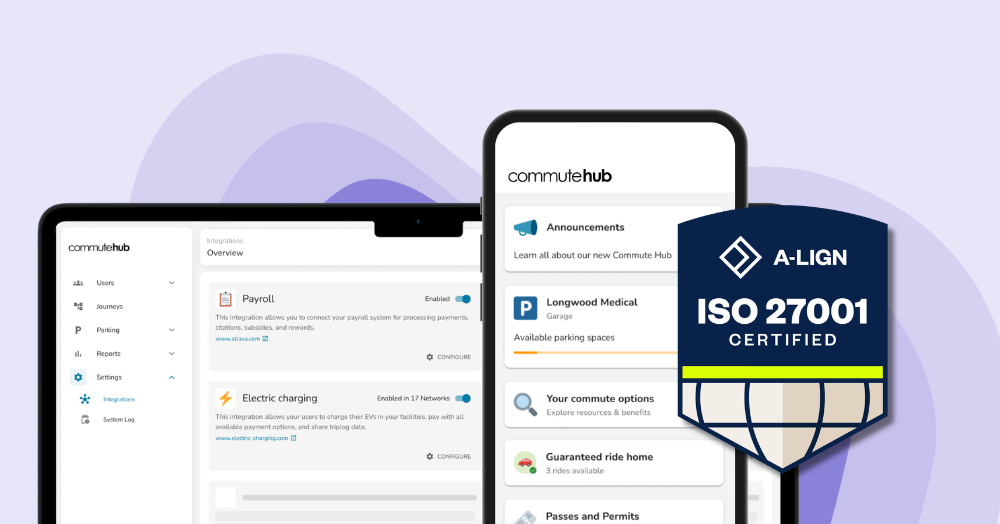
When organizations choose RideAmigos CommuteHub, they’re doing more than adopting a commute management platform. They’re connecting us to their HR and payroll systems, trusting us to manage parking operations, relying on us to support compliance reporting for their employees, and even entrusting us to serve an entire region with commute options. That’s not routine software usage. It’s a level of operational trust that we don’t take lightly. That’s why RideAmigos earned ISO 27001, the leading international standard for information security management systems
The employees commuting through our apps are real people — at hospitals, universities, tech campuses, and government agencies — and the programs their employers run on our platform us are central to how those organizations function. We feel the weight of that. It’s why security has always been a priority for our team, and it’s why we made the decision to formalize that commitment through independent certification.
Formalizing best practices
Certification wasn’t the beginning of our security story — it was the formalization of it.
Since we first launched our award-winning SaaS platform, we have been vetting third-party systems before integrating them, following secure coding practices, running phishing simulations, performing independent penetration tests, and managing access carefully. We were also conducting external audits against ISO 27001 standards. These weren’t practices we adopted to prepare for certification — they were already how we operated, because that’s how we believed software should be built, especially given what our customers were trusting us with.
Formal certification was the natural next step. As RideAmigos has grown and our integrations have deepened, we felt it was important to formalize our security standing. The certification confirmed what we had already built. It also gave us a structured framework to document, improve, and clearly demonstrate it to the customers who depend on us.
Why RideAmigos pursued ISO 27001
Many software companies pursue SOC 2 certification, and it’s a legitimate, well-regarded standard. We want to be clear: SOC 2 is not a weak choice. In fact, the AWS infrastructure that hosts RideAmigos operates within SOC 2 Type II compliant facilities, so we already benefit from that baseline.
But when we looked carefully at the two frameworks, ISO 27001 asked more of us and that’s what we wanted.
While SOC 2 is a point-in-time snapshot of your security controls, ISO 27001 is a continuous audit against an international standard. SOC 2 brings in an independent auditor to review your controls during a defined period and attest to their effectiveness. It answers the question: did this company’s security practices meet the criteria during this period? ISO 27001 asks a different question: does this company operate a living security management system, one that continuously identifies risks, responds to them, and improves? Achieving and maintaining ISO 27001 certification means building what’s called an Information Security Management System (ISMS): a structured, documented, and independently audited approach to security that doesn’t reset at the end of an audit cycle. It runs every day.
That ongoing accountability is what sets ISO 27001 apart for us. It reflects how we believe security should work and not as a snapshot, but as a practice.
How we keep your data safe
ISO 27001 didn’t introduce new security practices to RideAmigos, but it provided a framework to document, connect, and continuously validate our approach. A few that we think matter most to our customers:
- Penetration testing. We conduct regular third-party penetration tests of our systems by independent security professionals attempting to find vulnerabilities before anyone else does. This isn’t a one-time exercise; it’s part of an ongoing cycle of testing and remediation.
- Access control and least-privilege policies. Access to data and critical systems is granted based on role and need, reviewed regularly, and revoked promptly when circumstances change. Limiting access limits exposure.
- Incident response planning. We maintain a documented, tested incident response plan. If something goes wrong, we don’t figure it out in the moment, but we follow a defined process for containing, investigating, communicating, and recovering from security events.
- Vendor risk management. Our security doesn’t stop at our own walls. We assess the security practices of third-party vendors who touch our systems or data, because a chain is only as strong as its weakest link.
- Employee security awareness training. Every member of the RideAmigos team receives regular security training. Most security incidents begin with human error — phishing, weak credentials, misconfigured access. Training is one of the most effective controls we have.
None of these practices exists in isolation. ISO 27001 requires us to document how they connect, review whether they’re working, and improve them over time. That’s the difference between having good security instincts and operating a security program.
Building a strong security culture
One of the things ISO 27001 made real for us is that security can’t live only in the engineering or IT function. The standard requires genuine organization-wide participation, and going through the certification process surfaced that clearly.
That means our team members in customer success, operations, and leadership are part of our security posture, not bystanders to it. It means security awareness is a regular part of onboarding and ongoing training. And it means that when something looks off, like an unusual email, an unexpected access request, or a system behaving strangely, everyone on our team knows they have a role to play. That kind of security culture is harder to earn than any audit finding, and we’re proud of it.
ISO 27001 is not a finish line. It’s a framework we will maintain, audit, and improve as our platform evolves and as the security landscape changes. We’ll continue to hold ourselves accountable to the standard, not because we have to, but because our customers deserve nothing less.
Soon, customers and partners will be able to access documentation and resources in our self-service compliance portal powered by Vanta. In the meantime, if you have questions about our security practices, our certification, or how we handle your organization’s data, reach out to your customer success team, email help.rideamigos.com.