Parking management system software offers a long list of operational benefits. It makes life easy for program administrators by automating permits, collecting payments, and enforcing parking policies equitably and fairly. Purpose-built parking software can also help you identify hidden revenue opportunities and base your parking-related capital allocation decisions on hard data rather than personal anecdotes.
Yet, for many organizations, parking management platforms can support policies that reinforce a culture of sustainability. Workplace leaders who are serious about sustainability know that parking is a powerful lever for prompting commuter behavioral change.
From this viewpoint, the core transportation demand management (TDM) question changes from “How can we maximize the efficiency of our parking capacity?” to “How can we use parking policy to influence commuter behavior?”
To the latter end, consider these concepts:
- Every operational inefficiency is a sustainability setback
- Smarter parking policy drives modal shift
- Parking is an important entry point to your mobility ecosystem
By viewing parking policy through a sustainability lens, you can start to reimagine what parking management system software can help you achieve.
Every operational inefficiency is a sustainability setback
Manual approaches to parking management are often spread out across fragmented systems that duplicate effort, drain resources, and quietly undermine your sustainability objectives. This baked-in waste comes with a sustainability cost that your organization may not be accounting for — or even aware of.
This waste can create headwinds for your sustainability objectives, through issues like:
- Manual daily capacity management: When your staff spends their time on tasks like ad-hoc permit adjustments, policy enforcement, and program tinkering, your organization loses budget and bandwidth. This drains resources that you could be using on commuter incentives, trip reduction programs, and mode-shift initiatives that would meaningfully move the sustainability needle.
- On-site customer service at full lots: When lots reach capacity, sending someone to redirect arriving commuters isn’t just an additional labor cost. It adds friction to the commuting experience. If your organization’s parking program is chaotic, commuters become less likely to trust or try the modal alternatives your TDM efforts depend on.
- Fragmented systems becoming unsynchronized: When your parking and TDM programs live in separate platforms, parking data that should be informing your commuting strategy can be missing, delayed, or contradictory. Unreliable parking data makes it needlessly difficult to make informed decisions about policies that drive behavior change among commuters.
- Reactive, labor-intensive enforcement: Manual enforcement is costly, imprecise, and runs the risk of being unequally or unfairly implemented. There’s another cost, too, which is often hidden: Without intelligent occupancy and policy violation data, you’re missing the demand signals that should be informing your TDM and commuter management program design.
When used strategically, parking management system software eliminates all of these wasteful inefficiencies by turning labor-intensive manual tasks into easy automation. This not only cuts waste, but also frees up organizational resources. You can then redirect those resources into your sustainability programs.
Smarter parking policy drives modal shift
When it comes to modal choice, two factors are well-known to impact commuter behavior: the availability of parking, and its cost. If you use separate systems to manage your commuter programs and your parking, you’re leaving your most powerful control point disconnected from your sustainability strategy.
By unifying your TDM and parking management system software into a single platform, you can leverage data and real-time insights to design and implement smart policies that drive modal shift. Examples include:
- Daily choice parking: Rigid monthly and annual parking permits lock both commuters and organizations into sunken costs. A simple shift into employee daily choice parking removes a psychological barrier that keeps commuters tied to default habits. By removing that barrier, you can prompt commuters to consider their transportation mode day by day. At scale, this can have a massive impact.
- Parking cash-out programs: Parking cash-out programs are very effective at prompting behavior change. They offer permit holders the opportunity to give up their parking privileges in exchange for a cash payment. Parking cash-out programs dramatically reduce parking demand, which helps organizations reduce their parking spend while guiding commuters to adopt sustainable alternatives for the long term.
- Preferential access and pricing splits: Rewarding carpoolers and electric vehicle (EV) commuters with preferential access to charging infrastructure and better parking spots creates an immediate and tangible sense of reward and recognition.
- Capacity caps and surge pricing: When delivered in real time, scarcity signals give commuters powerful organic incentives to consider more sustainable alternatives to solo driving. By leveraging this to encourage mode shift during peak-demand days, your compliance and emissions reporting will benefit.
Parking management system software makes it easy to implement and configure these and other strategies directly in your commuter management platform. Also, note that none of these strategies inherently require your commuter base to harbor strong sustainability convictions. Instead, they simply work to make sustainability the most convenient or financially sound choice.
Parking is an important entry point to your mobility ecosystem
For commuters who use cars to get to work, parking is the most familiar and common touchpoint for interacting with your broader TDM programs. If you rely on fragmented tools and legacy strategies to manage your parking programs, you’re missing out on a major opportunity to attract commuters to smarter transportation options.
Here’s why:
In siloed parking management systems, commuters usually just log in, manage their permits, then log out. The entire interaction begins and ends with parking.
Specialized software changes the entire architecture of that exchange: Parking management becomes embedded with trip-planning tools, rideshare matching, commuter incentives, and all the other strategies you’re using to drive participation. The visibility you gain can dramatically reshape commuter engagement with your sustainability initiatives.
Personalization also becomes a key factor. The modal options your users find during those system-level interactions can be tailored to their locations, schedules, and commuting histories. This creates a level of immediacy and relevance that can mean the difference between a person noticing the availability of modal alternatives and actually acting on them.
These integrations go even further, extending to Scope 3 reporting, vehicle-miles traveled (VMT) targets, and local trip-reduction compliance requirements. All that data is generated, authenticated, and connected to reporting platforms without any extra effort or labor.
Advance your sustainability goals with parking management system software
Parking has always been a core element of the commuter experience. With the right platform, it can become just as important to your sustainability strategy.
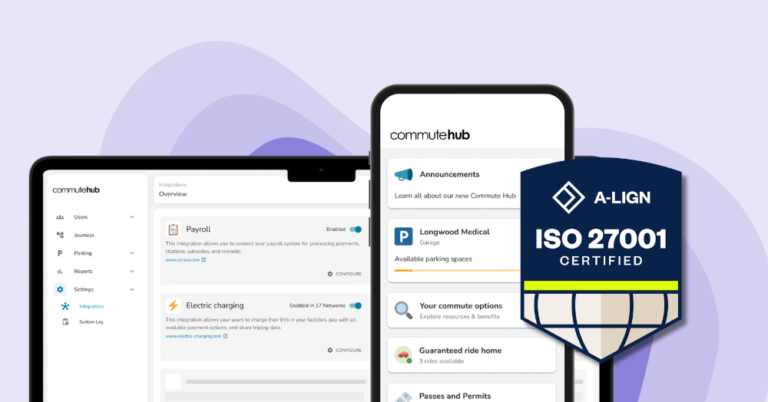
CommuteHub unifies parking management with your complete TDM program by automating complex workflows, displaying personalized mobility options during peak moments of commuter engagement, and connecting behavioral data directly with your tracking and reporting programs. The result is a parking management solution that doesn’t just manage demand, but actively shapes it in ways that support your sustainability goals.
Ready to see CommuteHub in action? Contact a RideAmigos expert to arrange your personalized platform demo.